T.L.E Learning Module
  • Home
  • Courses
    • Beauty Care >
      • Beauty Care Module
      • Additional Resources
      • Lesson 3
      • Lesson 4
    • Carpentry >
      • Lesson 1
      • Lesson 2
      • Lesson 3
      • Lesson 4
      • Lesson 5
    • Cookery >
      • Lesson 1
      • Lesson 2
      • Lesson 3
      • Lesson 4
      • Additional Resources
    • Dressmaking >
      • Lesson 1
      • Lesson 2
      • Lesson 3
      • Lesson 4
      • Lesson 5
    • Electronics >
      • Lesson 1
      • Lesson 2
      • Lesson 3
      • Lesson 4
      • Lesson 5
    • Electrical Installation and Maintenance >
      • Lesson 1
      • Lesson 2
      • Lesson 3
      • Lesson 4
      • Lesson 5
    • Horticulture >
      • Lesson 1
      • Lesson 2
      • Lesson 3
      • Lesson 4
    • Household Services >
      • Lesson 1
      • Lesson 2
      • Lesson 3
  • About
  • Modules

Lesson 3:
​PERFORM MENSURATION AND CALCULATION

Picture
LEARNING OUTCOMES:
At the end of this Lesson, you are expected to do the following:
  • LO 1: Select measuring instruments; and
  • LO 2: Carry out measurement and calculations.
Definition of Terms
  • Area – extent of part of a surface enclosed within a boundary.
  • Calculation – the act or process of or result of calculating.
  • Circumference – distance around the circle.
  • Classification – group or category within an organized system.  
  • Decimal – number expressed in a counting system that uses units of 10, especially a decimal fraction.
  • Dimension – measurable extent such as length, thickness and width.
  • Fraction – number expressed as a quotient of two other numbers.
  • Geometric Shapes – characterized by straight line, regular curves and angles.
  • Graduation – scale of a measuring tool .
  • Mensuration – act or art of measuring.
  • Perimeter – bounding line or curve of a plain area.
  • Standard – serves as a measure of reference.
  • Stock – refers to a lumber for a certain furniture job.
  • Substrate – wood to be cut in a cutting machine.
  • Volume – space inside a solid figure.
Learning Outcome 1:
Select measuring equipment
Information Sheet 1.1
TYPES OF MEASURING TOOLS
Picture
Pull push rule
   1.  Pull-push rule – used for measuring long pieces of stock. 
Picture
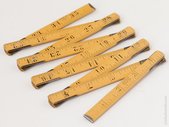
Zig zag rule
    2. Zig Zag Rule – a folded measuring tool. 
Picture
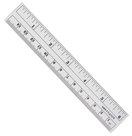
Ruler
    3. Ruler – used for measuring short pieces of stock. 
Picture
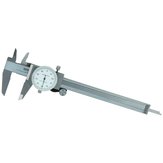
Caliper
  4. Caliper – used for measuring diameter.  
Picture
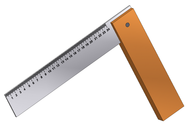
Try square
  5. Try Square – used for checking flatness and squareness. 
Picture
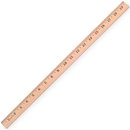
Meter Stick
  ​6. Meter Stick – a measuring device which is one (1) meter in length. 
Picture
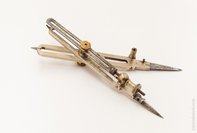
Divider
  7. Divider – used for dividing distances
Picture
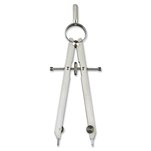
Compass
  ​8. Compass – used for scribing arcs and circles.
Picture
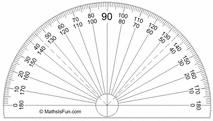
Protractor
​  9. Protractor – used for laying out angles.  

HANDLING OF MEASURING INSTRUMENTS / TOOLS 
            A. DO’S 
  1. Wipe measuring tools/instruments before returning them to the storage room.
  2. Oil the movable parts of the measuring tools such as zigzag rules, calipers, dividers and compasses to avoid stock-up.
  3. Make sure that grits like sand do not get inside the housing or case of a pull-push rule to avoid wearing off of the graduations.
  4. Check the lock of a pull-push rule if it is working. 
            B. DON’T’S 
  1. Do not wipe off edges of the steel tape of pull-push rule with bare hands to avoid injury.
  2. Do not pull the steel tape of pull-push rule too much to avoid the coil spring from damage.
  3. Do not use the caliper as tongs. 

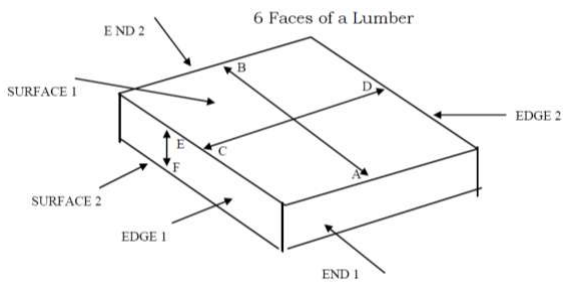
​LINEAR MEASUREMENTS FOR THE 6 FACES OF LUMBER
Hence; the linear measurements obtained are:
  1. End 1 to end 2 or A B = Length (L )
  2. Edge 1 to Edge 2 or C D = Width ( W )
  3. Surface 1 to surface 2 or E F = Thickness / Height ( T / H )  
Picture
Learning Outcome 2:
​Carry out measurement and calculations
Information Sheet 2.1
SYSTEM OF MEASUREMENTS
              The two (2) systems of measurements are: the English and the Metric System. The English system originated in England also known as the U.S. customary system of measurement while the Metric System was developed in France and also known as the S. I. (International Standard). 
I.    (UNIT OF MEASURES) - LINEAR MEASUREMENT 
ENGLISH 
Yard ( yd )
meter Foot ( ft ) / („ )
decimeter 1/10 
METRIC
meter 
decimeter 1/10 meter 
centimeter 1/ 100 meter 
​millimeter 1 /1000 meter
II. READING OF MEASUREMENTS 
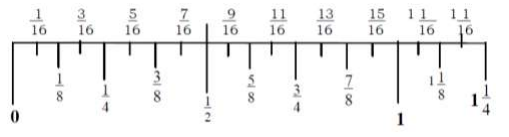
        A. Reading the inch
               The inch is divided into segments called graduations. Each graduation represents a measurement in form of a proper fraction. The inch can be divided into 16, 8, 4 and 2, equal parts. 
Picture
​Note: The illustration is not the actual lengh of an inch.
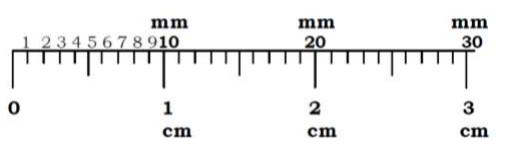
        B. Reading the centimeter and milimeter 
Picture
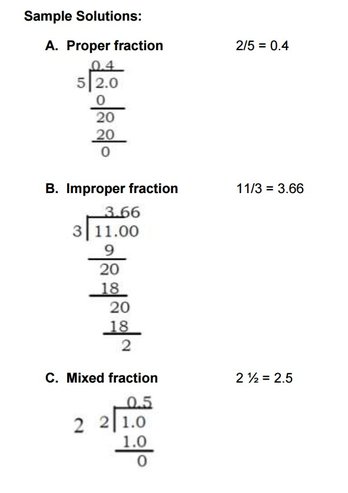
III. CONVERTING FRACTION TO DECIMAL
               In converting fractions to decimals, divide the numerator by its denominator whether it is proper, improper or mixed fraction. 
Picture
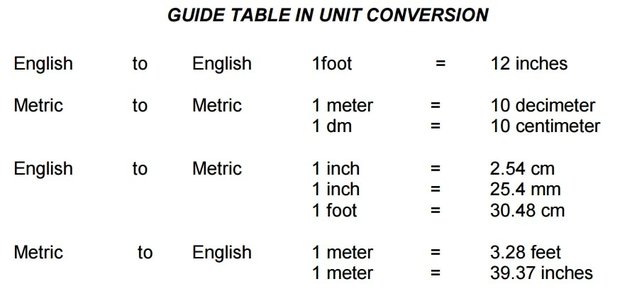
IV. CONVERTING UNITS OF MEASURE 
Picture
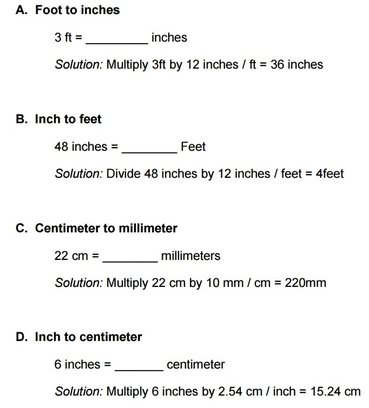
​Sample Solutions in Conversion
Picture
V. TAKING DIMENSIONS
Ways of taking dimension 
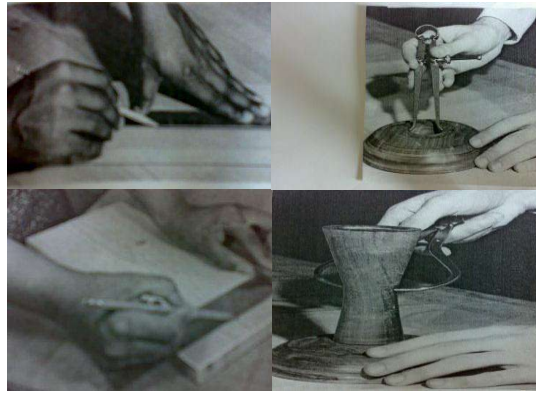
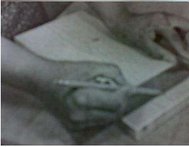
     ​1. Measure end to end of stock with a tool 
Picture
     ​2. Measure edge to edge with a tool 
Picture
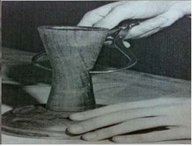
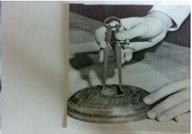
     3. Measure outside diameter of a cylindrical object using a caliper
Picture
​     4. Measure inside diameter with a caliper
Picture
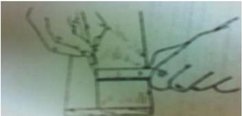
     ​5. Lay-out width
Picture

CALCULATING BOARDFOOT OF LUMBER
               ​Although the International System (SI) or Metric System had already superseded the English System of measure, the board foot as a unit of measure for determining the volume of lumber is still being used by the furniture & cabinet maker and construction industry. This is because lumbers are sold in terms of board foot. 
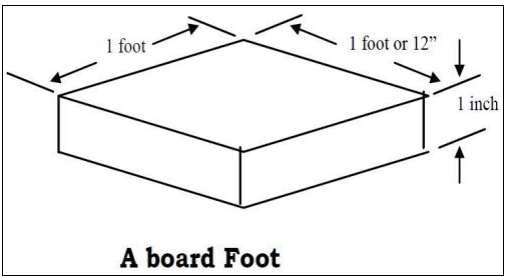
               A board foot is actually one square foot of lumber of one inch thick
Picture
The formula used in computing board foot is:
Board foot (Bd. Ft.) = T x W x L 12
         Where:
  • T = Thickness in inches
  • W= Width in inches
  • L = Length in feet

​Note: This formula is being used for sawed wood of commercial dimension. 
Example: Compute the board foot of lumber whose dimension is 2” x 4 “x 12”
​
Steps 1. Identify the given data       
    Given.
  • T = 2”
  • W = 4”
  • L = 12‟
Step 2. Determine what is being asked
           Find the Bd. Ft. = ?
Step 3. State the formula
           Formula: Bd. Ft. = T x W x L
                                                      12
​Step 4. Substitute the given data in the formula, then solve.
           Solution:
           Bd. Ft. = T x W x L 
                                    12
           = 2” x 4” x 12 “ 12
           = 96/12
           = 8 Bd. Ft

Additional Information:
Return to Lesson 2
Proceed to Lesson 4
Powered by Create your own unique website with customizable templates.
  • Home
  • Courses
    • Beauty Care >
      • Beauty Care Module
      • Additional Resources
      • Lesson 3
      • Lesson 4
    • Carpentry >
      • Lesson 1
      • Lesson 2
      • Lesson 3
      • Lesson 4
      • Lesson 5
    • Cookery >
      • Lesson 1
      • Lesson 2
      • Lesson 3
      • Lesson 4
      • Additional Resources
    • Dressmaking >
      • Lesson 1
      • Lesson 2
      • Lesson 3
      • Lesson 4
      • Lesson 5
    • Electronics >
      • Lesson 1
      • Lesson 2
      • Lesson 3
      • Lesson 4
      • Lesson 5
    • Electrical Installation and Maintenance >
      • Lesson 1
      • Lesson 2
      • Lesson 3
      • Lesson 4
      • Lesson 5
    • Horticulture >
      • Lesson 1
      • Lesson 2
      • Lesson 3
      • Lesson 4
    • Household Services >
      • Lesson 1
      • Lesson 2
      • Lesson 3
  • About
  • Modules